Understanding Indirect Light: Where Exactly Should You Place Your Plants?

Light is the literal fuel that drives the engine of plant life. Without it, every drop of water and every grain of fertilizer you provide is essentially useless. Yet, the term “bright, indirect light” remains one of the most confusing and poorly understood concepts for indoor gardeners. When you bring home a new plant and read that little plastic tag promising it loves indirect light, you might assume any corner of the room will do. However, the biological reality of a plant is far more demanding. Understanding how light moves through your home and how to gauge its intensity is the fundamental difference between a plant that is slowly starving and one that is truly thriving.
At its core, indirect light is light that reaches a plant’s leaves after reflecting off another surface or passing through a medium that scatters its energy. Think of it like the difference between standing in the middle of a desert at noon versus sitting under a wide porch on a sunny day. In the first scenario, photons are hitting your skin or a leaf with intense thermal and radiation power. In the second, you are surrounded by a bright, ambient glow that illuminates everything without scorching the surface. This is exactly what most tropical houseplants crave. In their ancestral homes, the rainforests, they live under a dense canopy of trees where they never see the sun directly, but exist in a world that is incredibly bright.
The Physics of Indoor Light and Window Orientations
To find the perfect sweet spot for your plants, you first need to become an expert on the geography of your own home. Not all windows are created equal. The direction a window faces determines the flavor of light it provides and how long that light lasts. North facing windows are the most stable source of low level indirect light. They never receive direct sun, making them ideal for low light heroes that cannot handle heat. South facing windows, conversely, are the powerhouses of the home. The trick here is distance. A spot three or four feet away from a southern window is often the Goldilocks zone of bright indirect light, whereas the windowsill itself might be a death trap for sensitive leaves.
East and west windows offer entirely different vibes. Eastern light is that gentle morning glow that provides great energy without the searing heat, making it a favorite for almost all indoor greenery. Western light, however, is the late day scorcher. It can stay cool for hours and then suddenly become incredibly intense and hot in the late afternoon. To truly understand your space, watch your shadow. If your shadow is faint and blurry, you are in a low light zone. If your shadow is clear but has soft edges, you have found the holy grail of bright indirect light. If your shadow is sharp, dark, and crisp, your plant is in the danger zone of direct sunlight.
The Inverse Square Law: Why Distance is Everything
There is a scientific reality that many plant parents ignore. Light intensity drops off at a staggering rate as you move away from a window. In physics, this is known as the Inverse Square Law. If you move your plant from three feet away from a window to six feet away, the light does not just get cut in half. It actually drops to a quarter of its original intensity. This means a corner that looks bright enough to your human eyes might be a total blackout for a plant’s photosynthetic system.
Our human eyes are incredibly adaptable. They adjust to dim light so quickly that we do not realize how dark a room actually is. But plants do not have that luxury. For a plant, light is food. When you place a sun loving Monstera in the middle of a room far from a window, you are essentially putting it on a starvation diet. The plant will begin to stretch, a process called etiolation, where the stems become thin, pale, and weak as they reach desperately toward the nearest light source. This leggy growth is a silent scream for more energy.
Hidden Obstacles and the Magic of Diffusion
Sometimes, the window is perfect, but the outside world gets in the way. Large trees, neighboring buildings, or even a wide balcony can turn a bright window into a low light situation. You have to assess the quality of the light, not just the direction. If a tree is dappling the sunlight, you actually have a natural filter that mimics a jungle canopy, which is a treasure for plants like Hoyas or Philodendrons.
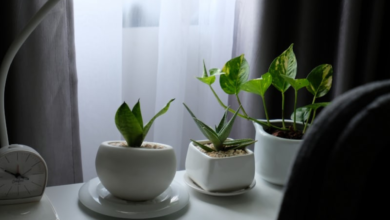
Curtains are also a secret weapon. Sheer white curtains are perhaps the best investment you can make for your indoor jungle. They allow the light energy to pass through but break up the infrared rays that cause leaf burn. With sheers, you can place almost any plant directly in front of a high energy window. Keep in mind that your wall color matters too. White or light colored walls act as reflectors, bouncing light back into the dark corners of the room and giving your plants extra photons they would not otherwise receive in a dark painted room.
Categorizing Your Indoor Light Zones
To simplify your plant placement, try thinking of your room in terms of specific zones based on light intensity. This mental map will help you make better decisions the next time you bring a new leafy friend home.
The Three Tiers of Indoor Lighting:
The Bright Indirect Zone: This is right in front of a window with a sheer curtain, or the area just to the side of a sunny window where the sun’s rays never actually touch the leaves.
The Medium Indirect Zone: This is the center of a well lit room, about five to eight feet from a large window, where you can easily read a book without a lamp all day long.
The Low Light Zone: Hallways, corners, and rooms with north facing windows fall here. Only the toughest plants like Snake Plants or ZZ Plants should live here.
Signs Your Plant is in the Wrong Light:
Bleached or Crispy Leaves: This is a clear sign of sunburn from too much direct light.
Reverting Variegation: If your beautiful white splashed leaves are turning solid green, the plant is struggling to survive the darkness.
Leaning Toward the Window: If your plant is tilting at a forty five degree angle, it is telling you its current spot is too dim.
Dormant Growth: If it is springtime and your plant has not put out a single new leaf, it probably does not have the fuel to grow.
The Connection Between Light, Water, and Feeding
It is a huge mistake to treat light as something separate from watering. There is a direct, mathematical relationship between the two. A plant in a bright indirect spot is photosynthesizing rapidly, which means it is drinking water and processing nutrients at a high speed. If you move that same plant to a darker corner, its metabolism slows down to a crawl. If you keep watering it on the same schedule, the water will sit in the soil, the roots will not be able to absorb it, and you will end up with root rot.
The same applies to fertilizer. Fertilizer is a multivitamin, not the meal itself. If a plant is not getting enough light, adding more fertilizer will not make it grow. It will actually burn the roots because the plant does not have the light energy needed to process those minerals. Before you reach for the watering can or the fertilizer bottle, always ask yourself if the plant is getting the right amount of light for its current metabolic rate.
Ultimately, mastering light is about observation. Do not be afraid to move your plants as the seasons change. A spot that was perfect in the summer might be way too dark in December when the sun is lower in the sky. By paying attention to the shadows and the leaves, you will eventually develop an eye for light that no app or light meter can replace. Treat light as the primary nutrient, and your indoor jungle will look like something off a magazine cover.